
Kilimanjaro Climb Duration: How Many Days for the Best Success Rate?
May 18, 2026

Afrishare Trekking & Safaris
Understand the science of acclimatization on Mount Kilimanjaro. Afrishare’s technical analysis shows why a 5 to 9-day duration is vital for reaching 5,895m safely.
Operational Dynamics of Altitude Adaptation: A Technical Assessment of Expedition Duration on Mount Kilimanjaro for Afrishare Trekking and Safaris
The determination of an optimal duration for ascending Mount Kilimanjaro, the highest peak in Africa and the largest free-standing mountain on Earth, represents a complex intersection of physiological science, logistical management, and environmental adaptation. Rising to a height of 5,895 meters (19,341 feet), the mountain presents a formidable challenge that necessitates a nuanced understanding of how the human body reacts to extreme decreases in atmospheric pressure and oxygen partial pressure. Analysis conducted by the expedition leadership at Afrishare Trekking and Safaris indicates that the duration of a trek—typically ranging from five to nine days—is the most significant controllable factor influencing both the safety of the participants and the statistical probability of reaching Uhuru Peak. While the physical distance of established routes varies from 53 to 98 kilometers, the temporal allocation is governed by the biological requirements of acclimatization rather than mere walking speed
The Physiological Imperative of Gradual Ascent
The primary constraint on the speed of a Kilimanjaro expedition is the physiological requirement for altitude adaptation. At sea level, the atmosphere contains approximately 20.9% oxygen, but as altitude increases, atmospheric pressure drops, leading to a corresponding decrease in the partial pressure of oxygen. At the summit of Uhuru Peak, the effective oxygen available to a climber is nearly 50% of that available at sea level. When the human body is exposed to this reduction too rapidly, the compensatory mechanisms—such as increased respiratory rate and heart rate—may fail, leading to Acute Mountain Sickness (AMS). In severe cases, this progresses to life-threatening conditions including High Altitude Pulmonary Edema (HAPE) and High Altitude Cerebral Edema (HACE).
Scientific research, including studies cited by the International Climbing and Mountaineering Federation (UIAA) and academic reviews by Dr. Martin Burtscher and Dr. Urs Hefti, emphasizes that a slow and gradual ascent is the most effective preventative measure against high-altitude illness. This principle is formalized in the "Climb High, Sleep Low" strategy, where trekkers ascend to higher altitudes during the day to stimulate physiological adaptation but return to lower elevations to sleep, allowing for recovery and the production of additional red blood cells.
| Duration (Days) | Statistical Success Rate (%) | Primary Limiting Factors |
|---|---|---|
| 6 Days | 27 % | Rapid elevation gain; high risk of AMS |
| 6 Days | 44% - 60% | Exhaustion on summit night; minimal rest |
| 7 Days | 64% - 85% | Balanced acclimatization; moderate physical toll |
| 8 Days | 85% - 90% | Excellent pacing; high energy for summit |
| 9 Days | 95% - 98% | Maximum adaptation; highest safety margin |
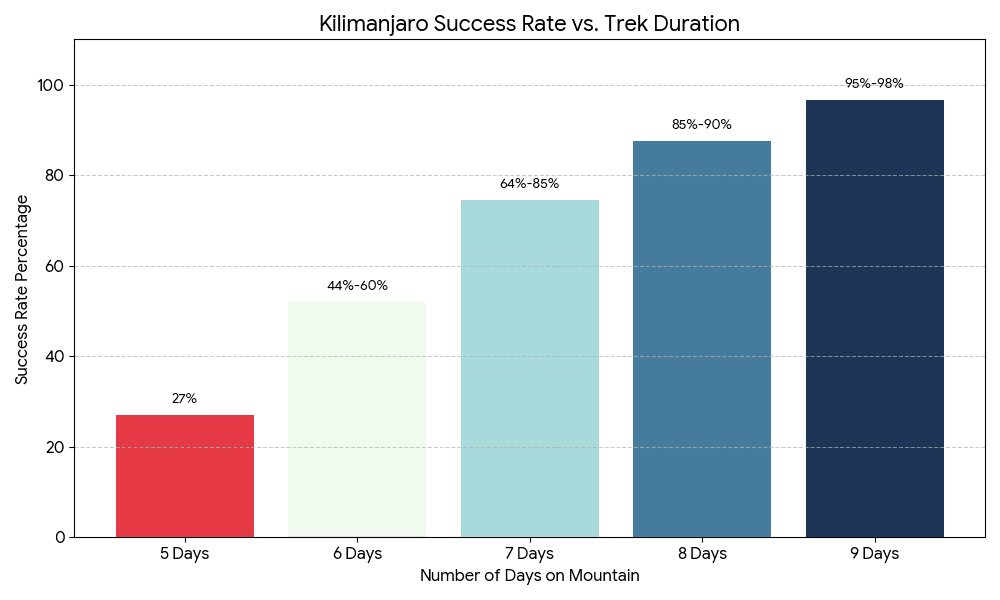
The correlation between expedition length and summit success is stark. Itineraries lasting only five days, primarily offered on the Marangu and Umbwe routes, suffer from failure rates as high as 73%. Conversely, the Northern Circuit, which spans nine days, provides the highest success rate on the mountain at over 95%, primarily due to its extended period in the "moorland" and "alpine desert" zones, which allows the body to stabilize before the final ascent
Comparative Route Dynamics and Temporal Allocation
Afrishare Trekking and Safaris utilizes seven established routes, each offering distinct temporal profiles and environmental challenges. Selecting the appropriate route requires a detailed assessment of a climber's previous altitude experience, fitness level, and risk tolerance.
The Northern Circuit: Maximum Acclimatization
The Northern Circuit represents the longest and most comprehensive route currently available on Mount Kilimanjaro. Typically requiring nine days, this route circumnavigates the northern slopes of the mountain, providing nearly 360 degrees of panoramic views and access to the quietest trails. The trek begins in the west at the Londorossi Gate and follows the Lemosho path for the initial two days before veering north near the Lava Tower to traverse the rarely visited northern face.
The temporal benefit of the Northern Circuit lies in its ability to keep climbers at an advantageous altitude for several days without overtaxing their physical reserves. Day 3 and Day 4 involve trekking through the "Garden of the Senecios" and reaching landmarks like the Lava Tower (4,600m) for lunch before descending to sleep lower at Moir Camp (4,200m). This prolonged exposure to the mid-mountain altitudes ensures that the final push from School Hut to Uhuru Peak is conducted by a body that has essentially completed the majority of its red blood cell synthesis.
The Lemosho Route: Aesthetic and Physical Balance
The Lemosho route is widely regarded by professional guides as the most scenic approach to the summit. It typically requires seven to eight days and is highly recommended for its gradual ascent profile. The route traverses the Shira Plateau from west to east and eventually joins the Machame trail near the Barranco Wall.
The eight-day Lemosho itinerary is particularly effective because it allows for shorter daily distances in the critical transitional zones between 3,500 and 4,600 meters. For instance, Day 4 on an eight-day trek involves a manageable ascent to the Lava Tower, whereas a shorter itinerary might compress this into a grueling ten-hour day.7 This pacing preserves muscle glycogen and mental resilience, which are the primary psychological currencies required during the final summit attempt.
The Machame "Whiskey" Route: Challenging Scenery
The Machame route is perhaps the most popular route on Kilimanjaro, accounting for approximately 50% of all trekkers.9 Known for its "Whiskey" moniker to contrast with the "Coca-Cola" Marangu route, it is steeper and more physically demanding. While it can be completed in six days, Afrishare experts strongly advise the seven-day variation.
The critical difference between the six and seven-day Machame itineraries is the distribution of fatigue. On the six-day trek, summit night begins after a long Day 5 hike to the Barafu base camp, leaving climbers with only four to five hours of sleep before the midnight start. This leads to a "zombie-like" state on the final slopes where success is determined by raw determination rather than physical readiness. The seven-day version inserts a short trekking day before base camp, allowing for a full afternoon of rest and hydration, which statistically increases the summit success rate by nearly 20%.
The Marangu and Umbwe Routes: The Risk of Speed
The Marangu route is unique as the only path providing hut accommodation, but its five-day itinerary is notorious for causing AMS due to rapid elevation gain. Many trekkers underestimate the challenge because the trail is technically simpler, yet the physiological toll remains the same. The Umbwe route, meanwhile, is the steepest and most direct path, recommended only for elite-level trekkers who have pre-acclimatized on other peaks.
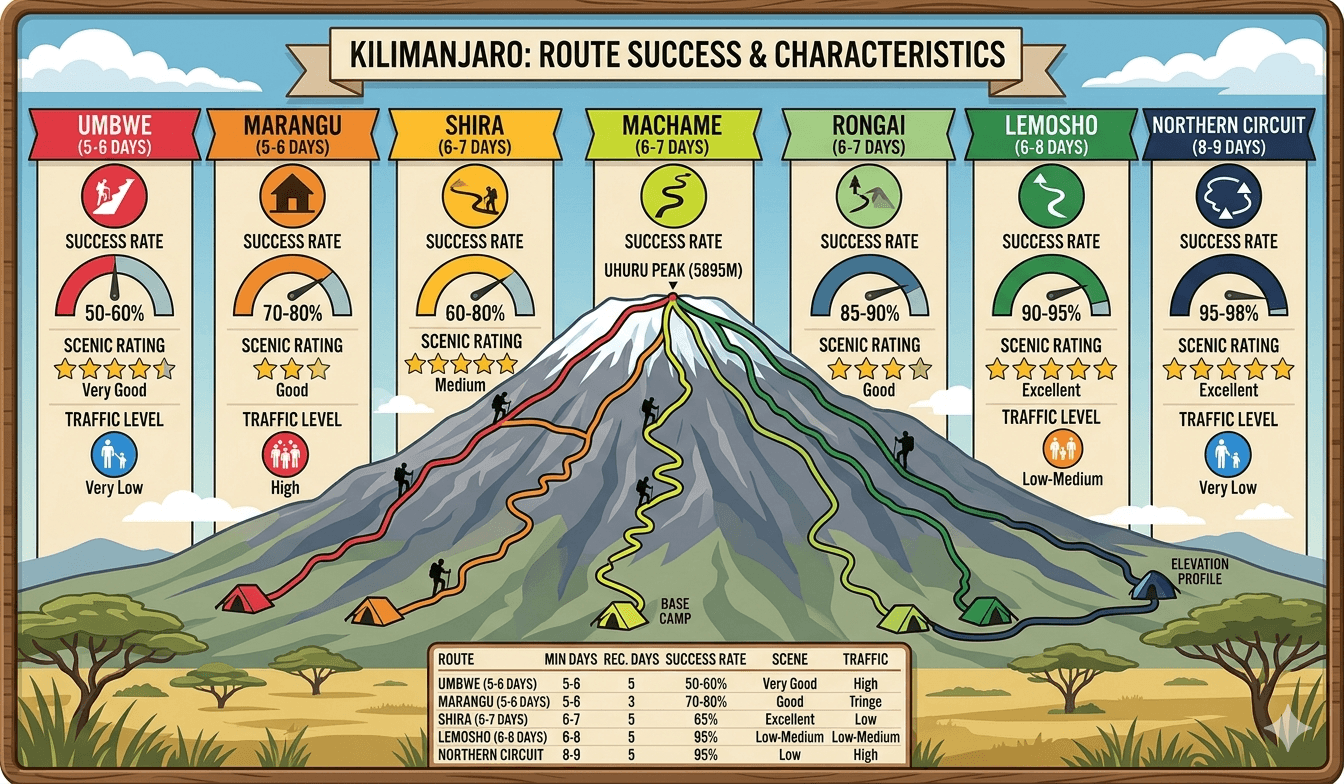
| Route Name | Min. Days | Rec. Days | Success Rate (%) | Scenic Rating | Traffic Level |
|---|---|---|---|---|---|
| Northern Circuit | 8 | 9 | 95-98% | Excellent | Very Low |
| Lemosho | 6 | 8 | 90-95% | Excellent | Low-Medium |
| Machame | 6 | 7 | 85% | Excellent | High |
| Rongai | 6 | 7 | 85-90% | Very Good | Low |
| Marangu | 5 | 6 | 70-80% | Good | High |
| Shira | 6 | 7 | 60-80% | Excellent | Medium |
| Umbwe | 5 | 6 | 50-60% | Very Good | Very Low |
Operational Strategy: The Afrishare Support Framework
Afrishare Trekking and Safaris operates with a specialized operational framework that prioritizes safety and success through an elite crew and rigorous protocols. The company, founded and led by Ibrahim, who maintains a 100% safety record, employs senior guides such as Moses, with over 15 years of mountain experience, and Okuli, who has reached the summit more than 200 times.
The core of the Afrishare methodology is the guide-to-climber ratio. The company maintains a strict standard of one guide for every two to three climbers, which is significantly higher than the industry average. This staffing level is essential for managing a diverse group; if one climber needs to move slower or descend due to illness, the rest of the group is not compromised. Furthermore, the guides are certified Wilderness First Responders and experts in high-altitude physiology, conducting twice-daily health checks using pulse oximeters to monitor oxygen saturation and heart rates.
Equipment and Logistical Readiness
The duration of a climb is heavily influenced by the quality of the support equipment. Afrishare ensures that every expedition is equipped with emergency oxygen cylinders, pulse oximeters, and comprehensive first-aid kits. For many climbers, renting high-quality gear locally in Moshi is a more efficient use of time than transporting heavy equipment internationally.
| Equipment Item | Function | Rental Price (USD) |
|---|---|---|
| Sleeping Bag (-20°C) | Critical for recovery at high camp | $25 |
| Oxygen Cylinder | Supplemental safety for summit night | $120/trip |
| Trekking Poles (Pair) | Stability and knee protection | $10 |
| Headlamp | Essential for the midnight summit push | $10 |
| Down Jacket | Thermal protection in the Arctic zone | $20 |
| Private Toilet | Hygiene and group comfort | Included/Variable |
Proper footwear is the only equipment category where rental is discouraged. Afrishare experts emphasize that boots must be "broken in" prior to arrival to prevent blisters, which can terminate a trek as quickly as altitude sickness. The use of trekking poles is also highlighted as a vital time-saving tool, as they can reduce the impact on the knees by up to 25% during the grueling 3,000-meter descent from the summit.
Nutritional Requirements at Extreme Altitude
Maintaining a positive energy balance is one of the most significant challenges during a multi-day trek. At altitudes above 4,000 meters, the human body often experiences a loss of appetite and an increase in basal metabolic rate. Afrishare’s culinary team, led by professional mountain cooks, provides three hot, nutritious meals daily, specifically designed to counter these effects.
The nutritional strategy focuses on high-carbohydrate intake. Carbohydrates are the most oxygen-efficient fuel source, requiring 8-10% less oxygen to metabolize than proteins or fats. Studies integrated into the Afrishare protocol suggest that a high-carb diet can effectively mitigate AMS symptoms, theoretically reducing the perceived altitude impact by up to 1,000 feet at moderate elevations.
Typical Afrishare Mountain Menu:
- Breakfast: Hot oat or millet porridge, Spanish omelets, sausages, baked beans, and fresh fruit. Hot beverages like cocoa, tea, and coffee are essential for morning hydration and core temperature maintenance.
- Lunch: Hot soups (zucchini, pumpkin, or leek), sandwiches, pasta dishes, and local staples like Ugali. On Day 1 and Day 8, high-energy packed lunches including fried chicken, fruit, and chocolate are used during transit
- Dinner: Soup starters followed by main courses such as beef or chicken curry with rice, spaghetti Bolognese, or roasted potatoes with cooked vegetables (spinach, cabbage). Desserts such as fruit salad or pancakes are provided for immediate recovery
Hydration is managed through the provision of at least three to four liters of boiled and filtered water daily. Guides monitor water intake rigorously, as dehydration mimics the symptoms of AMS and can lead to unnecessary evacuations
The Strategic Advantage of Mount Meru Pre-Acclimatization
For climbers concerned about the duration and difficulty of the Kilimanjaro trek, the integration of a pre-acclimatization climb on Mount Meru is a highly effective strategy Located within Arusha National Park, Mount Meru stands at 4,566 meters (14,980 feet) and offers a concentrated high-altitude experience that mimics the conditions found on the upper slopes of Kilimanjaro
Afrishare’s Mount Meru programs typically last three to four days and result in a 15-20% increase in Kilimanjaro summit success rates The biological mechanism at play is the stimulation of erythropoiesis—the production of red blood cells—and the adjustment of blood pH levels to compensate for lower carbon dioxide concentrations By reaching the summit of Meru, which is equivalent in height to Kilimanjaro’s high camps (Kibo or Barafu), the body has already completed its most difficult adaptive hurdles
| Comparison Feature | Mount Meru | Mount Kilimanjaro |
|---|---|---|
| Peak Elevation | 4,566 meters | 5,895 meters |
| Primary Difficulty | Steepness / Scrambling | Altitude / Endurance |
| Wildlife Encounters | Very High (Safari-like) | Low (primarily Forest) |
| Accommodation | Mountain Huts | Tents (most routes) |
| Success Rate | 90-95% | 60-80% (Average) |
Beyond the physiological benefits, Mount Meru offers a distinct wildlife experience, with giraffes, buffaloes, and warthogs frequently spotted on the lower slopes It provides a psychological "rehearsal" for the summit night experience on Kilimanjaro, including a pre-dawn start and a challenging ridge traverse, without the extreme hypoxia associated with the higher peak
Environmental and Ecological Progressions
The duration of a Kilimanjaro trek is not merely a passage through distance, but a journey through five distinct ecological zones. Each zone has its own temporal demands and visual rewards, which Afrishare guides incorporate into the daily educational briefings
Cultivation Zone (800m - 1,800m): Characterized by lush plantations of coffee and bananas. The air is warm and humid, and the gradient is typically gentle
Rainforest Zone (1,800m - 2,800m): A dense canopy where rain is frequent and the trails are slippery. This zone is the most biodiverse, home to the Blue Monkey, the Black-and-White Colobus Monkey, and the endemic Impatiens kilimanjari
Heather-Moorland Zone (2,800m - 4,000m): The forest thins into open spaces dominated by giant heathers and the iconic Dendrosenecio kilimanjari (giant groundsel). This zone is critical for the initial stages of acclimatization
Alpine Desert Zone (4,000m - 5,000m): A stark, volcanic landscape where temperatures fluctuate from scorching solar radiation during the day to freezing nights. Vegetation is sparse, limited to lichens and hardy grasses
Arctic Zone (Above 5,000m): The final 1,000 meters of the climb. This is a region of ice, snow, and glaciers. Liquid water is non-existent, and the atmospheric pressure is at its lowest
The Dendrosenecio kilimanjari is of particular scientific interest, as it represents a unique evolutionary adaptation to the mountain’s "summer every day, winter every night" climate. These plants grow very slowly—often only a few centimeters a year—and can live for centuries They retain their dead leaves to insulate the trunk against the nocturnal freeze, a biological strategy that mirrors the layering systems worn by the climbers themselves
Seasonal Temporal Variations
The weather on Kilimanjaro follows a bimodal pattern of dry and wet seasons, which significantly impacts the speed and safety of the trek. Afrishare leadership recommends scheduling expeditions during the primary dry seasons: from late June to October and from December to mid-March
| Month | Weather Condition | Impact on Trekking |
|---|---|---|
| Jan - Feb | Dry and Warm | High visibility; popular for holiday treks |
| Mar - May | Long Rains | Slick trails; low visibility; high failure rate |
| June | Transition | Cooler; drying trails; fewer crowds |
| July - Aug | Dry and Cold | Peak season; stable weather; busy trails |
| Sept - Oct | Dry and Clear | Optimal conditions; manageable crowds |
| Nov | Short Rains | Unpredictable showers; quiet mountain |
| December | Transition | Rain increases; busy for New Year's |
During the "long rains" of April and May, success rates can drop from the usual 80% to approximately 60% The mud in the rainforest and moorland zones slows the daily pace, and the psychological burden of being cold and wet for six days can sap the motivation required for the final summit push Afrishare recommends the Rongai route during wetter months, as the northern side of the mountain receives significantly less rainfall than the southern faces
The Anatomy of the Summit Night Push
The most critical temporal segment of any Kilimanjaro expedition is the final 24 hours. Regardless of whether the preceding journey was seven or nine days, the summit push is a logistical and physical outlier
The decision to summit at night—typically starting between 11:00 PM and midnight—is based on tactical mountaineering principles. The frozen scree (volcanic gravel) provides a firmer surface for the ascent; once the sun rises, this material thaws and becomes unstable, making the climb twice as difficult Furthermore, the goal is to reach Uhuru Peak at sunrise (approximately 6:00 AM to 7:00 AM) to enjoy the clearest visibility before the afternoon clouds and winds ascend the mountain
The mental toll of the night push is extreme. Climbers operate in near-total darkness, guided only by headlamps and the "pole pole" (slow) cadence of their guides High-altitude fatigue, combined with the freezing temperatures (often -10°C to -20°C), creates a meditative state where every step requires a conscious effort of will. The final 200 meters from Stella Point to Uhuru Peak along the crater rim is often the most exhausting, as the altitude of 5,700m+ significantly impacts motor skills and respiratory efficiency
The Descent Dynamics
A common error among trekkers is underestimating the time and energy required for the descent. After reaching the summit, climbers must descend nearly 3,000 meters in a single day The knees and quads bear the brunt of this impact, particularly on the steep scree slopes between the summit and the high camps Afrishare itineraries include a final night at a lower camp (such as Mweka or Millennium at 3,100m - 3,900m), ensuring that climbers return to oxygen-rich air for recovery as quickly as possible, reducing the risk of HAPE which can develop even after a successful summit
Ethical Considerations: Porter Welfare and Sustainability
The speed and success of a Kilimanjaro climb are inextricably linked to the welfare of the porters. These individuals carry the heavy infrastructure—tents, food, and equipment—that makes the multiday trek possible Afrishare Trekking and Safaris is a TATO (Tanzania Association of Tour Operators) accredited member and strictly adheres to ethical labor standards
The industry standard, enforced by Afrishare, limits the weight carried by porters to 20 kg (including their personal gear), ensuring they are not overtaxed. Providing porters with adequate nutrition, warm clothing, and professional wages is not only a moral obligation but a safety imperative. A well-cared-for crew is more attentive to the needs of the climbers, particularly during the dangerous summit night where porter support can be the difference between a safe descent and a medical emergency
Afrishare also practices "Leave No Trace" tourism, ensuring that the mountain remains preserved for future generations. This includes carrying out all waste and utilizing eco-friendly toilet facilities, reflecting a commitment to the long-term ecological stability of the Kilimanjaro National Park
Strategic Planning for Potential Climbers
To determine the ideal length for a Kilimanjaro climb with Afrishare, a tiered approach based on experience and goals is recommended.
- For the First-Time High-Altitude Trekker: The 9-day Northern Circuit or the 8-day Lemosho route. These options provide the highest safety margin and allow for a more enjoyable immersion in the mountain’s various climate zones.
- For the Time-Constrained but Fit Adventurer: The 7-day Machame or 7-day Rongai route. These require a higher baseline of fitness but still offer a reliable "climb high, sleep low" profile.
- For the Experienced High-Altitude Athlete: The 6-day Machame or 6-day Marangu routes may be considered, but only if preceded by the 4-day Mount Meru acclimatization trek
The "Afrishare Advantage" lies in the personalized nature of the planning process. Every climber is encouraged to discuss their medical history and fitness routine with the expedition leads, allowing for the customization of the itinerary—such as adding a rest day or adjusting the daily walking speed—to ensure the highest probability of standing on the "Roof of Africa"
Technical Summary of Temporal Variables
The total time spent on the mountain is the product of several distinct variables, which are summarized in the table below for comparison across the Afrishare service catalog.
| Expedition Phase | Temporal Allocation | Critical Success Factors |
|---|---|---|
| Preparation (Pre-climb) | 2-3 Months | Aerobic and strength training; breaking in boots |
| Transit to Gate | 3-4 Hours | Final gear check in Moshi/Arusha |
| Rainforest Phase | 1-2 Days | Hydration; steady pace; wildlife observation |
| Moorland Adaptation | 2-3 Days | "Climb High, Sleep Low" maneuvers; caloric intake |
| Alpine Desert Prep | 1-2 Days | Rest; mental preparation for summit night |
| The Summit Push | 12-16 Hours | Cold-weather gear; pacing; guide support |
| Descent to Gate | 1-2 Days | Joint protection (poles); rapid altitude loss |
In conclusion, the question of "how long" it takes to climb Kilimanjaro is answered not by a single number, but by a strategic choice. For the vast majority of climbers, the investment of an extra one or two days on the mountain is the most cost-effective insurance policy available. It transforms a grueling survival exercise into a once-in-a-lifetime journey through the clouds, culminating in a triumphant sunrise at Uhuru Peak. Under the stewardship of Ibrahim and the veteran guides at Afrishare Trekking and Safaris, climbers are provided with the scientific, logistical, and culinary support necessary to master the temporal demands of the mountain and reach the summit safely